


How AI can help us better understand the brain and mental illness

Merci beaucoup pour votre témoignage.
Could you outline the educational path that led to your PhD?
Before my PhD, I did a bachelor’s and a master’s in mathematics. After finishing my master’s, I really wasn’t expecting to work on topics such as brain illness. But I knew that people with a background in mathematics or computer science who work on AI can easily explore applications in almost any scientific field. During my master’s internship, I applied AI to high performance computing (HPC) for a project aimed at estimating future CPU performance from hardware metrics. While I enjoyed coding and figuring out which models best suited the project, I realized how important it is to understand your application domain well and be truly driven by its research question. I also noticed that the majority of the engineers who had control over their subjects, who actively kept up to date with the literature, conducted rigorous research, and had fun with their projects, had PhDs. I figured that in order to be able to do the same, I needed to learn how to be a researcher. So I started looking for a PhD. That’s when I discovered that AI could be applied to neuroscience, and more specifically, to psychiatry. The idea of working on computational projects while learning about the brain and participating in furthering our knowledge of mental illness was very exciting to me. In October 2022, I started my PhD at NeuroSpin, a research institute dedicated to neuroimaging and all that surrounds it. Researchers there study the physics of magnetic resonance imaging, how and where consciousness arises in the human brain, how psychiatric illness and brain aging are encoded in the brain and evolve over time, how genetics relate to brain signals, and more. For the next three and a half years, I was part of the Signatures team, whose aim is to find neuroanatomical signatures of psychiatric illness.
Can you please briefly describe your PhD thesis work?
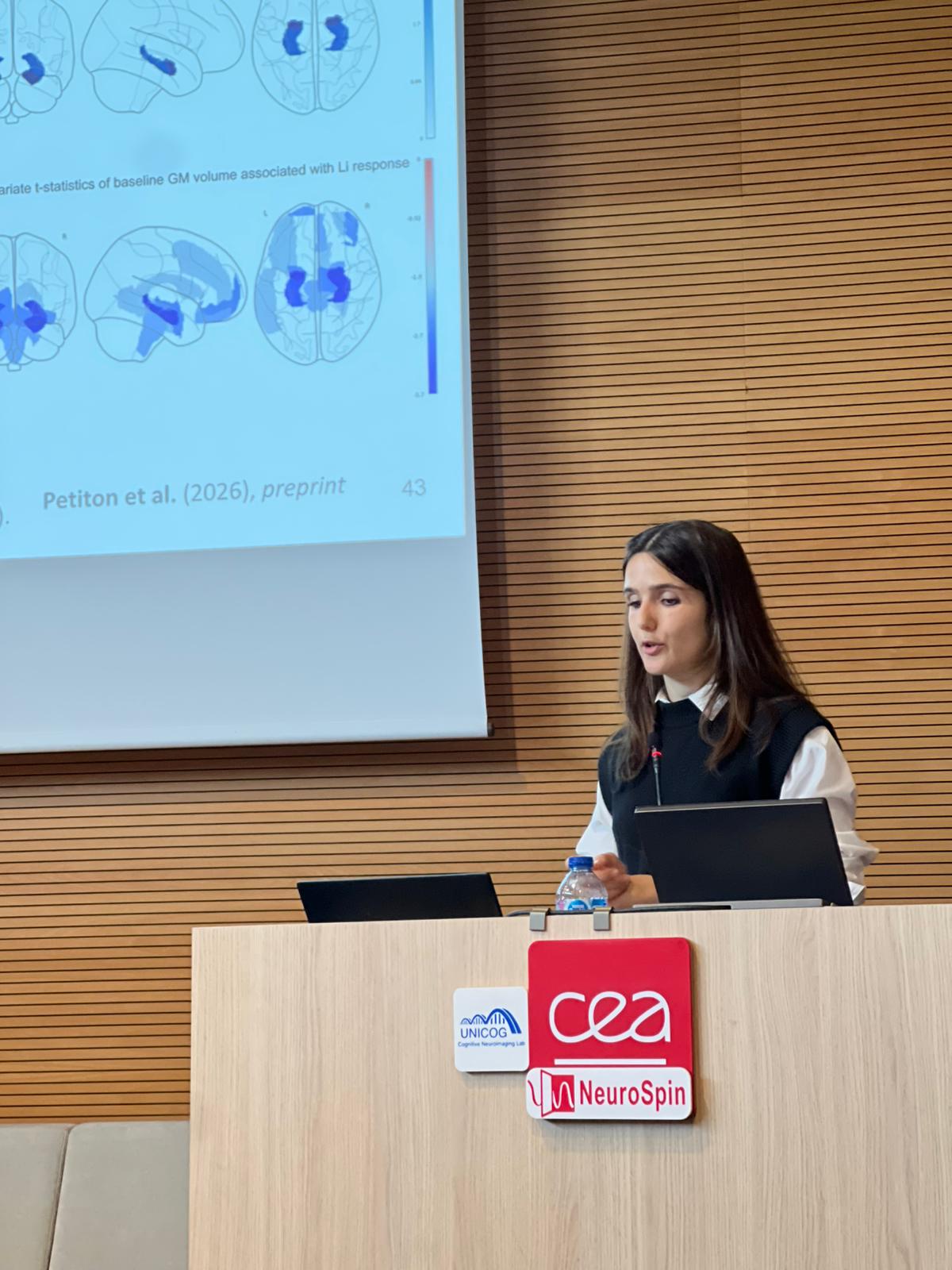
My PhD, entitled "Machine and Deep Learning Methods for Identifying Neuroanatomical Biomarkers of Bipolar Disorder", explored different models and feature representations to understand how the neuroanatomy of bipolar disorder deviates from the "healthy" norm. What makes the brain of a patient with bipolar disorder structurally different from that of someone without a brain illness? Using machine learning, deep learning, and normative models, I looked for the features (brain measures such as cortical thickness or gray matter volumes) and models (like convNets or SVMs) that best discriminated the MRIs of bipolar patients from those of healthy controls. As part of the European Research Project RLiNK, I also worked on estimating how bipolar patients respond to lithium treatment, using structural MRIs of their brain acquired before and three months after treatment onset. By analyzing how a model classified patients into good responders vs. non- or partial responders, we were able to identify candidate biomarkers of treatment response. This suggests that we could tell, from an MRI taken before treatment, whether a patient is more or less likely to respond positively to lithium, sparing the patient months of trial and error. Of course, these results need to be replicated on other datasets (which don’t necessarily exist yet) before they can be used clinically, but they are very encouraging and make me hope for better, more efficient ways to treat mental illness.
What qualities do you think are essential to succeed in a PhD?
If I’m being completely honest, I don’t think you should listen to people who tell you you need specific qualities to succeed in doing a PhD. All you really need is motivation and curiosity, which aren’t intrinsic qualities of someone’s personality but rather are things that hinge on your interest in your thesis subject. Prior to starting my PhD, I had no idea I could be this engaged in a subject or this motivated to work nights and weekends (which, by the way, you don’t have to do, except maybe before submission deadlines). I simply found machine learning, neuroscience, and psychiatry really interesting. Considering the current climate, I’d also add that not systematically relying on AI chatbots would help you succeed, because you need to learn how to think scientifically, question everything you read, and do the work on your own before automating any part of it. Research is based on furthering known science, whereas AI chatbots are mostly trained to predict the most probable next word. Unless you build a domain-specific model that can critically filter the literature, differentiating relevant papers from poorly reproducible ones, and pull useful information for your exact research questions, a chatbot won’t be of much use. Then again, building such a model would constitute a considerable amount of work, and you’d be acquiring a lot of the skills a PhD is meant to teach you in the same process anyway.
What advice would you give to a student who wants to pursue a PhD?
I would tell them to choose their team wisely, and to make sure not to neglect their health for their work. It’s never worth it. People work best when they are well rested. Going out for walks and taking both social and physical breaks helps relieve brain fog. Sometimes the best way to tackle a problem effectively is to step away and come back to it later. I would also encourage them to favor research subjects they wouldn’t be able to work on in a private company (unless they’re pursuing a CIFRE thesis in collaboration with industry). The great thing about pursuing a PhD is that it gives you the opportunity to work on research topics still in their infancy, which aren’t yet profitable for most companies, and for which there is still a lot left to discover. It’s worth keeping this in mind when choosing a subject, because if you ever wish to leave academia afterwards, very few companies will give you the chance to work on topics that aren’t developed enough to be monetized.


Commentaires