


Doing a PhD in a New Field: My Experience in Augmented Vision and Optics
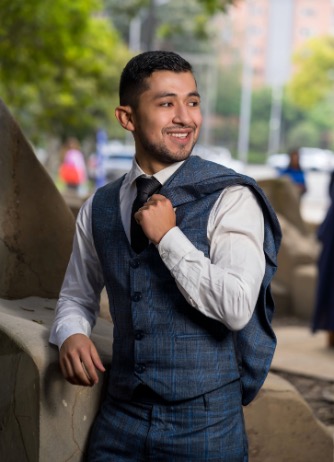

Merci beaucoup pour votre témoignage.
Can you tell us about your thesis in a few words?
I did my PhD in computer graphics at Université Paris-Saclay, in the Augmented Reality and Artificial Intelligence team, supervised by Christian Sandor, Richard Legras and Marie-Anne Burcklen. My thesis explored augmented vision: systems that enhance how we perceive the real world.
One application I worked on is presbyopia, the age-related loss of the eye's ability to refocus between far and near objects. Instead of a static lens, I built an optical system that can set the focus region by region, so objects at different distances can be sharp at the same time. The thesis had a strong optics component, which was not where I started.
Why did you decide to do a PhD?
My interest in research started early, during my bachelor's degree, when I joined a research lab as an intern. I quickly realised how much I enjoyed working on challenging problems that do not have a known answer yet. That feeling of exploring something new, and slowly understanding it, never left me.
When the time came to choose my next step, a PhD felt like the natural way to keep doing exactly that.
What was your biggest challenge? Did you have doubts?
Yes, I had many doubts, and they were my biggest challenge. My background was in mechanical engineering and computational geometry, and I was starting a topic that was relatively new to me: optics. Add the constant pressure of academia to publish, and it was easy to wonder whether I was going to accomplish it.
What helped me most was learning to be patient with myself. I was not going to be an expert overnight, and nobody expected me to be. I gave myself time to learn the fundamentals properly, step by step, and I accepted that being a beginner is a normal stage, not a failure.
What are you doing now?
I now work as an x-ray optics engineer at Synchrotron SOLEIL. The skills I built during my PhD in optical design, simulation and construction are what opened this door, even though I had no prior experience in x-ray optics.
I never imagined I would end up working on this topic. My PhD did not prepare me for one specific job; it taught me how to learn a difficult field quickly and build things that work.
What advice would you give to current doctoral students?
Trust yourself. If you arrived at the point of doing a PhD, it is because you are capable. It can be very hard not to compare yourself with others and feel overwhelmed, but remember who you are comparing yourself with: you are measuring yourself against some of the best people in your field.
Be patient, give yourself time to learn, and keep your mind open.


Commentaires