


From engineering sciences to brain-inspired research

Merci beaucoup pour votre témoignage.
Can you please describe your student journey until your PhD?
Following high school, I moved from Abidjan in Côte d’Ivoire to France, most specifically the city of Clermont-Ferrand, for my studies. I initially aspired to work in physics, specifically astrophysics and entered a bachelor of sciences in physics at first. After my first year, inspired by some introductory courses, I actually found myself an interest in engineering sciences. I had the occasion to pursue my second and third year in engineering sciences instead of physics and did so by moving to the engineering, specifically mechatronics, bachelor program. After getting my BSc, I had the chance to be awarded the scholarship of excellence “WOW! I-SITE CAP20-25” of Université Clermont Auvergne and pursued my studies with a masters of sciences in robotics, still at Université Clermont Auvergne. During my masters, I initially did not aim at going for a PhD but discovered in my internships in Institut Pascal the field of “brain-inspired computing”, that eventually captivated me to the point of wanting to do a PhD in the field.
Can you please briefly describe your PhD thesis work?
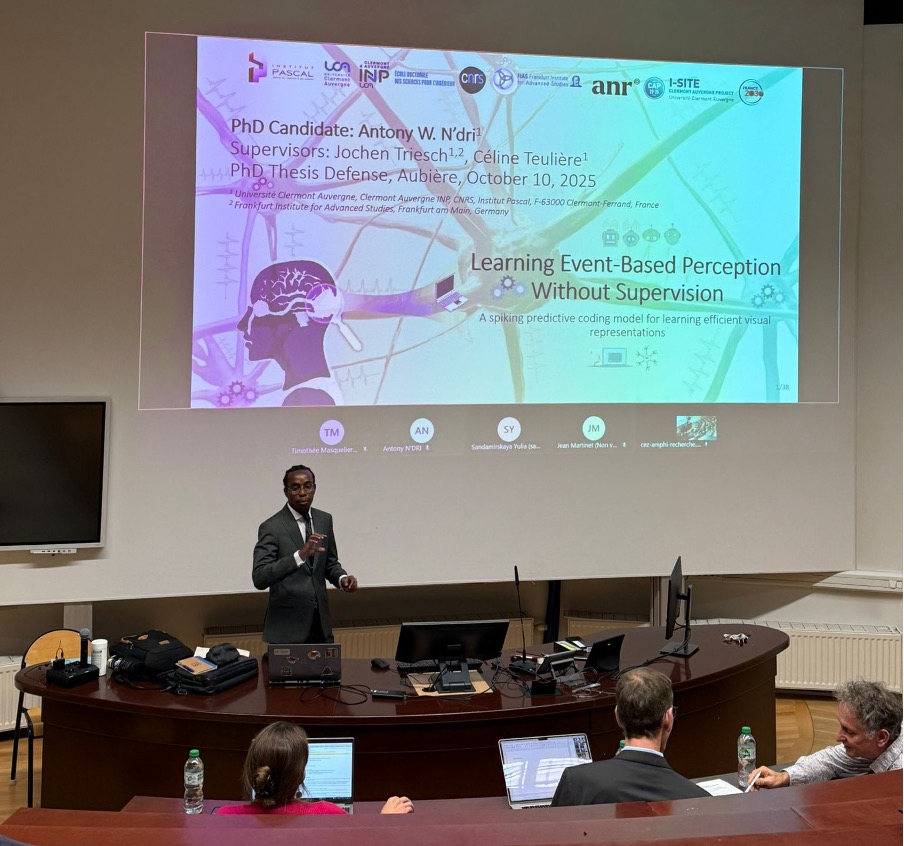
I did my PhD in Image, perception systems and robotics in Université Clermont Auvergne, in collaboration with Frankfurt Institute Advanced Studies in Germany. My PhD subject was at the frontier of AI, robotics and neurosciences. Essentially, in my work, I used a novel type of sensor called “event cameras” (that I initially discovered during my prior masters’ internships), to build vision processing algorithms. Event cameras are inspired from biological retina and output asynchronous data which make them difficult to use with traditional vision algorithms. Considering their biological inspiration, in my PhD, with my PIs (supervisors), we decided to develop brain-inspired methods that could perhaps better leverage this technology, and also help testing neuroscientific theories of brain functions. I developed novel algorithms based on spiking neural networks (termed the 3rd generation of neural networks) that were inspired from the predictive coding theory which is, currently, one of the most prominent theories of brain function in neuroscience. Importantly, in my work, I showed that such models could not only provide an explanation to some biological responses observed in humans’ brains, but could also be used in visual processing tasks such as object classification and have very little energy consumption contrary to other AI approaches.
In terms of personal values, what did your Ph.D. journey add?
I genuinely think that doing a PhD changed me deeply, from a fundamental level. While I have always been hardworking and rigorous, I would argue that doing a PhD made me even more rigorous, meticulous and careful regarding not only sciences, but how I tackle life in general. I personally tend to see things from a scientific lens now, regardless if it is some mundane everyday task, or some debates or discussions with friends. It also made me overall more empathetic to mental health issues in general and to solitude, as PhD (and, in my opinion, scientific career in general) is a pretty solitary journey which is hard on the mind. Still, I believe that undergoing a PhD helped me grow as an individual, and I like to think that it is akin to having a super power (laughs).
What were the key elements for the success of your thesis?
Personally, I’d say that three things helped me in succeeding in my PhD: 1) having good PIs. I found my PIs phenomenal. I learned everyday from them. Considering the solitary nature of the PhD, and how the only people that can actually understand what you are working on are your supervisors, I found myself extremely lucky to have such good-natured, understanding and qualified people as supervisors. While it wasn’t always easy, I can safely say now, with hindsight that this was indubitably one of the key elements behind getting my PhD. 2) having a strong and supportive social circle. I do not think that I would have survived a PhD without all of my lovely friends and family who were there from start to the end and saw me in what I consider some of the most difficult periods of my life. 3) being stubborn and never giving up. This last point is arguably the most important as it was, in my humble opinion, necessary to keep going even when nothing seemed to work research-wise.
What did you do after your thesis?
Since I defended my PhD, I temporarily left academia as I have been doing a postdoc with Orange Research, on the Sophia Antipolis site of the company. My postdoc focuses on similar fields as my PhD, with the development of efficient spiking neural network models, inspired from biological organisms, specifically insects here. I am currently finding this experience highly enriching and plan, at the time, to pursue my career with such brain-inspired research.


Commentaires