


From Optics and Lasers to Oxides that Change Their Mind

Merci beaucoup pour votre témoignage.
Can you tell us about what motivated you to start a thesis?
I first started working as a research assistant during my master's degree, and at that time I did not see myself doing anything else. Between my studies in Optics, Lasers and their Applications at the University of Bucharest, and my work at NILPRP Magurele using pulsed laser deposition to fabricate optical coatings, I had already caught the research bug. Starting a PhD felt like a natural next step.
How did you choose your PhD subject and what was it about?
One thing I was looking for was studying abroad, both for the life experience and as a career benefit. I chose France because I like an active lifestyle, and France is one of the developed countries with access to mountains, the ocean, and the sea in the same weekend. Great for work-life balance! The subject itself I chose pragmatically. My time as a research assistant had already shown me that I leaned more toward the device side of things than the purely optical one, so I thought about the future, alongside what I wanted to study and my own personality, and gravitated toward experimental work with techniques that translate directly into industry: reactive DC/RF magnetron sputtering, cleanroom nanofabrication, and material structural and electrical characterization.
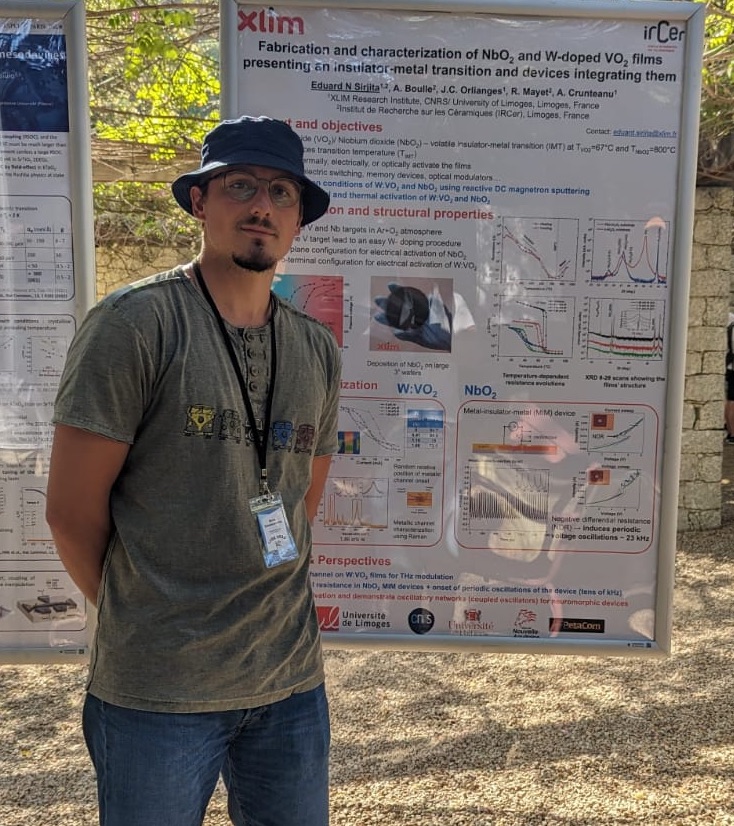
That's how I ended up starting a PhD at XLIM in Limoges, studying thin film oxides that undergo a metal-insulator transition, under the guidance of Dr. Aurelian Crunteanu, Dr. Alexandre Boulle and Dr. Jean-Christophe Orlianges, all amazing people from whom I’ve learned so much. I believe that one of the highlights of the PhD was going beyond the state-of-the-art modulation window for THz amplitude modulators. Other great parts I remember fondly are the people I met and places I saw (header photo shows me during a conference at the beach).
How hard is it to balance your time during the PhD?
Besides some special moments, I think I've done a good job. The secret is setting boundaries and knowing how to communicate with your supervisors. My general rule, I think I learned this from a Hans Selye book, is: experimental work in the morning when I'm energetic and focused, research and analysis later in the day. Good planning before starting an experiment also helps enormously. I hate redoing experiments because of avoidable errors or bad planning, so a solid plan buys both order and peace of mind.
What are the best non-technical skills you developed during your PhD?
Working in a lab with colleagues from a dozen different backgrounds made me far more adaptable in interpersonal terms, comfortable navigating a multi-ethnic, multicultural environment where communication styles and expectations vary from one person to the next. That same adaptability carried over into how I approach new problems: over my career I built up a personal toolbox of small research "hacks" that let me get up to speed on an unfamiliar subject quickly, instead of starting from zero every time. Presenting my work orally at conferences or team meetings and writing scientific publications also forced me to communicate complex ideas efficiently, tailoring the message to the audience in front of me. Finally, the PhD trained me to properly define an objective and break it down into a realistic path to get there, a skill that turned out to be just as useful outside the lab as inside it.
What was your professional experience after the thesis?
I used my materials science and engineering background to continue into a post-doc, following a simple rule: "something different enough that I learn new skills, but not so different that I abandon what I've already built". I'm currently a post-doc at IMN Nantes, working on In-Memory Computing using Mott Insulators, and I recently presented this work at ICNCE2026 in Aachen on Mottronics and neuromorphic hardware. This work is different enough, yet familiar, and it means my optics, materials, and device-physics background now feeds directly into building more efficient computing hardware.
What advice would you give someone who wants to start a thesis?
Choose with your head first, then your heart, always keeping the next step in view, not obsessively, but with a general direction in mind. Have a plan, or at least the idea of a plan, instead of just going with the motion of the ocean. The ocean is a wonderful place to spend a Sunday, less so a strategy for three+ years of research.


Commentaires